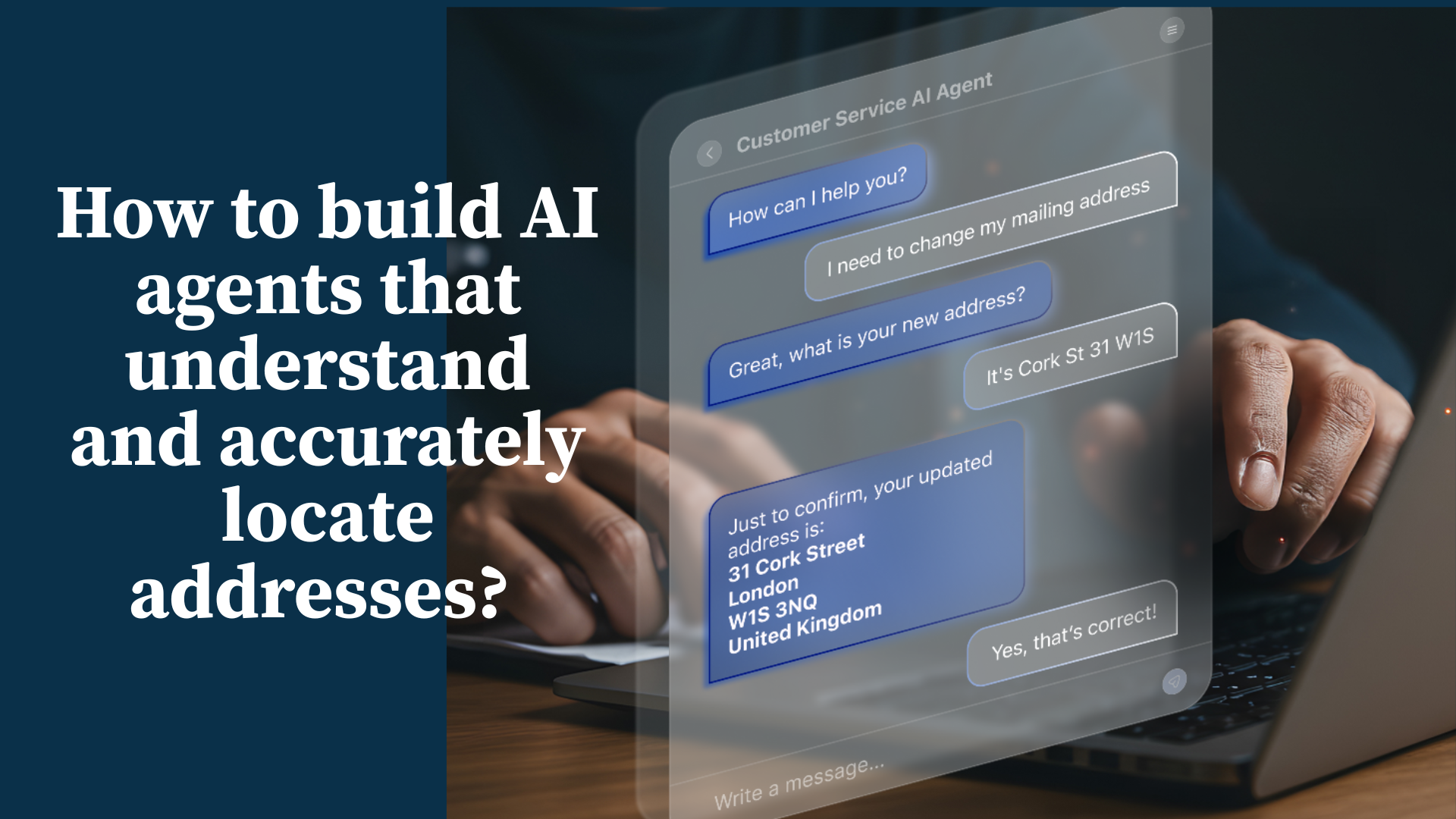
How to build AI agents that understand and accurately locate addresses?


The rise of AI agents and their hidden weakness
Across the UK, businesses are rapidly adopting AI agents to power customer service, logistics, and automation. From e-commerce retailers handling order queries to taxi firms managing bookings, AI is already transforming how companies operate.
Yet, for all their intelligence, AI agents have a critical blind spot: addresses .
While large language models can write code or summarise complex documents, they often fail when faced with something as simple as “12 Church Street.” They struggle to interpret incomplete or ambiguous address information and without verification tools, they do something far worse: they confidently get it wrong .
For businesses that rely on accurate location data, whether for deliveries, taxi pickups, or field operations, this blind spot can turn intelligent automation into costly inefficiency.
Why AI struggles with addresses
Traditional addresses were never designed for the conversational, context-rich environment of AI. Humans write and speak addresses in countless variations, and AI agents often receive this information buried within longer messages. Without structure or context, even the most advanced model can make incorrect assumptions.
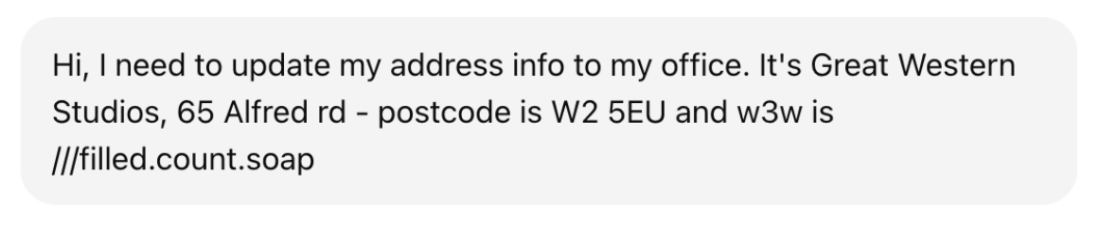
Common challenges with addresses include:
- Duplicate addresses: There are dozens of “Church Roads” across the UK and multiple “Lonsdale Roads” in London alone. When addresses share similar or identical details, AI can struggle to determine which is correct.
-
Incomplete or misspelled data:
Users rarely type full, perfectly formatted addresses in chat conversations.
-
Geocoding inaccuracies:
Even correctly formatted addresses don’t always pinpoint the exact delivery or pickup location. This is where users will share their what3words address to provide businesses with ultimate accuracy.
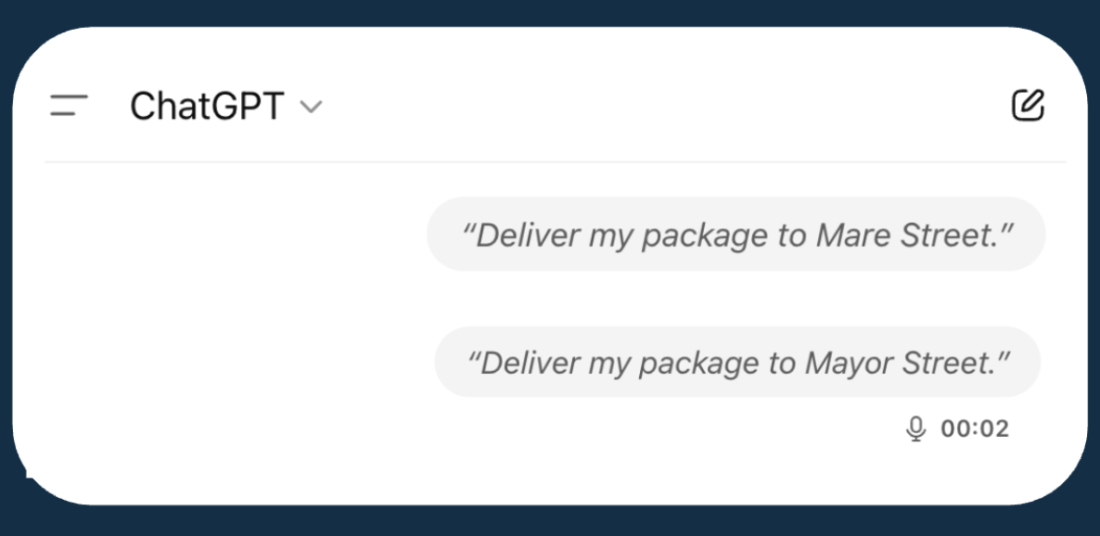
- Voice challenges: Street addresses aren’t designed to be spoken, creating errors in voice-based AI systems. Addresses that sound similar like Mayor Street can often be mistaken for the wrong address. Aka in this instance, Mayor Street is mistaken for Mare Street.
Addresses are usually collected in structured web forms, whereby businesses typically use address lookup and validation tools to collect accurate addresses. But in AI chats and voice interactions, those safety nets are missing. The result? Agents that appear competent, until an order goes missing or a customer is left standing at the wrong location.
Addresses are usually collected in structured web forms, whereby businesses typically use address lookup and validation tools to collect accurate addresses. But in AI chats and voice interactions, those safety nets are missing. The result? Agents that appear competent, until an order goes missing or a customer is left standing at the wrong location.
When “confidently wrong” costs your business
Poor address data doesn’t just cause frustration, it directly affects a company’s bottom line.
Retail & e-commerce:
When AI systems capture or confirm an invalid address, deliveries fail. This means more “Where’s my order?” (WISMO) enquiries, higher redelivery costs, and negative reviews that damage brand trust. A single incorrect postcode can send a parcel to the wrong city, or nowhere at all.
Taxi & mobility:
For taxi and ride-hailing services, a wrong address can mean missed pickups, wasted driver time, and unhappy passengers. An AI booking assistant that can’t correctly identify a location is worse than no assistant at all.
Infrastructure & field services:
When maintenance teams or engineers are dispatched to incorrect locations, delays multiply. Every wasted journey costs time, fuel, and customer confidence.
These are not edge cases, they’re everyday examples of what happens when AI systems try to handle human address data without validation.
How to build AI agents that understand and accurately locate addresses
The solution isn’t to train AI harder. It’s to equip AI with verified location data .
At what3words, we’ve developed two complementary, AI-ready solutions designed to eliminate address ambiguity and give businesses confidence in their automated systems:
-
Swiftcomplete
:
a real-time address lookup and validation tool built to work seamlessly within AI environments.
-
what3words AI
:
a precise, speakable addressing system that lets AI agents identify and verify exact locations anywhere on Earth.
Together, they give AI agents the ability to understand, validate, and act on location data accurately, no guesswork required.
Swiftcomplete: AI-ready address lookup and validation
Swiftcomplete brings the accuracy of traditional address lookup tools into the AI age. It allows conversational systems to interpret, format, and verify unstructured address data in real time.
Here’s how it works:
-
A user provides a partial or informal address within a chat or voice prompt.
-
The AI agent passes the information to Swiftcomplete.
-
Swiftcomplete identifies and validates the correct, complete address.
- The AI agent confirms it back to the user, correctly.
This means no more mis-typed postcodes or incomplete street names slipping through.
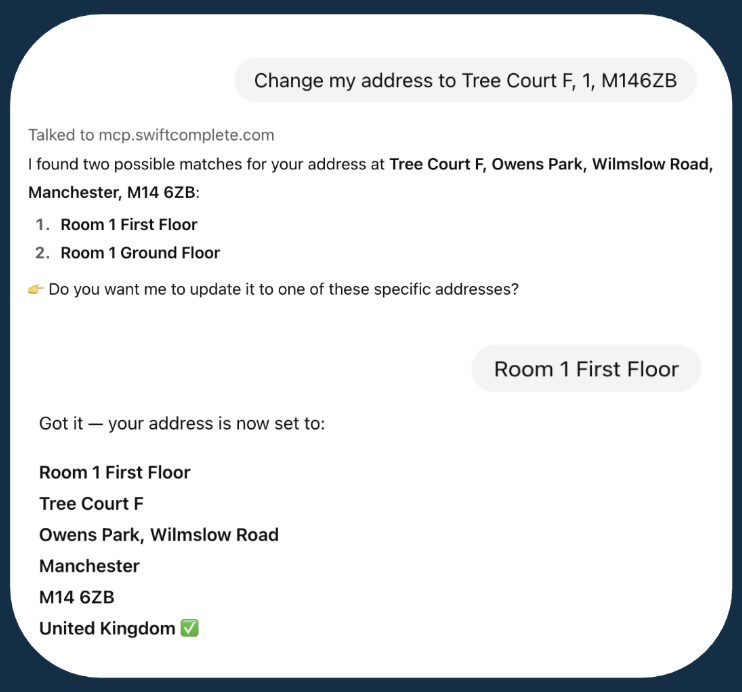
For example, when a customer tells a support agent “I’ve moved to 14 Church Rd,” Swiftcomplete can instantly check which Church Road they mean, format the address correctly, and update the customer record.
In retail, this prevents failed deliveries. In taxi dispatch, it ensures passengers are collected at the right spot. In infrastructure, it makes sure field engineers arrive exactly where they’re needed.
The image attached shows an example of someone sharing their partial address with a retailer to change their delivery address. When an AI agent has access to Swiftcomplete’s MCP server , the agent is able to respond to clarify the specific address – even including multi-residence address data e.g. room number and floor number.
Swiftcomplete ensures AI agents are not just confident – they’re confidently correct .
what3words AI: Precise locations for the agentic era
While address validation solves the problem of structured data, many AI interactions are moving beyond traditional formats entirely, especially in voice-based systems.
That’s where what3words AI comes in.
what3words has divided the world into a grid of 3-metre squares, each with a unique combination of three simple words, like ///apple.orange.table . This means every location on Earth has its own precise, fixed, and easy-to-say identifier.
It’s a system designed to be spoken , made up of short, clear, and unambiguous words, available in over 60 languages.
For AI agents, that means:
-
They can instantly recognise and verify what3words addresses within natural conversation.
-
Users can share their exact location verbally, without repeating long street names or postcodes.
- Businesses gain a level of precision impossible with traditional addresses.
A customer might say, “Pick me up at ///guitar.river.bright,” and the AI agent knows the exact 3-metre location, not just the building, but the correct entrance.
Bringing it together: verified addresses meet precise locations
By combining Swiftcomplete’s address validation with what3words’ precise location intelligence, businesses can build AI agents that handle any kind of address, street or what3words, with total confidence.
This integrated approach removes the guesswork and ensures every AI-powered interaction is grounded in verified, real-world accuracy.
A smarter future for AI-powered businesses
As AI agents become embedded in customer experiences, one truth stands out: trustworthy data drives trustworthy AI.
Retailers, taxi companies, and infrastructure providers depend on accurate location data to deliver great customer experiences. By integrating Swiftcomplete and what3words AI, these businesses can turn their agents into truly intelligent assistants, ones that understand, validate, and act on real-world addresses with precision.
Missed our webinar?
You can watch the recording on-demand here.