From palaces to airports: how what3words is transforming "How to find us" pages


You open The Shard’s contact page , scroll past the address and see a neat table of entrances: office reception, viewing gallery, hotel lobby, restaurants. Next to each is a three word address such as ///driven.degree.smile. On the British Museum’s Visit page , the Great Russell Street and Montague Place entrances both have their own three word address. Birmingham Airport’s parking pages list what3words location: ///degree.draw.vibe right beside the postcode.
These tiny lines of copy are easy to miss, but together they show a big shift in how organisations add precise locations online. For thousands of high-profile venues, what3words is now part of the standard pattern for “Contact us”, “How to find us” and “Getting here” pages.
In this post we look at how different types of venues are using what3words on these pages, why it helps visitors, and some simple patterns you can copy on your own site.
Why postcodes and share links are no longer enough
Traditional contact or visit pages still typically show a postal address, perhaps a Google Maps link and some written directions. That works fine for somewhere with a single door which happens to be accurate on the big map platforms. For large or complex sites, it often leaves people short of where they actually need to be. For small locations, they can either not feature on the big map platforms, or potentially point to the wrong place depending on how the data was added.
A stadium might have twenty turnstiles. An airport may have multiple car parks and drop-off zones. A museum could have separate step-free and stair-only entrances on different streets. A postcode will often drop people at the centre of a building footprint or even in the wrong car park, so visitors have to guess which gate or road to try next.
That’s inconvenient for everyone, and can be particularly stressful for visitors with access needs, families travelling with children, school groups and anyone working to a tight schedule (or simply wants to arrive at exactly the right place, first time!).
what3words divides the world into a grid of 3 metre squares and gives each one a unique combination of three words. By adding the right three word address to a contact page, a venue can point people to the precise place they should arrive, whether that’s a main entrance, a specific turnstile, an accessible side door, a loading bay or a coach park barrier.
The result is a small change on the website that makes arrival much more confident in real life.
Palaces, castles and historic sites
The iconic Buckingham Palace sets a clear example. On the Royal Collection Trust schools pages, it doesn’t just say “arrive at Buckingham Palace, London SW1A 1AA”. It specifies exactly which gate to use for certain workshops and gives a what3words address for the school groups entrance. Teachers can put that address into the what3words app or any enabled sat nav and be guided straight to the right gate, rather than just the palace railings (and find they need a long detour to get to where they actually need to go!).
This same approach now appears across the National Trust estate – for example at Chartwell in Kent, Avebury in Wiltshire, Plas Newydd in Wales and Runnymede in Surrey – where properties routinely include three word addresses for main entrances and car parks in their “Getting here” sections. Other famous historic sites have followed suit, including Chatsworth House , the Royal Yacht Britannia in Edinburgh and Dunvegan Castle on the Isle of Skye.
At Ironbridge Gorge Museums in Shropshire, the “How to get here” page includes a table with both postcodes and what3words addresses for each attraction. Blists Hill Victorian Town, Coalport China Museum and the Iron Bridge Tollhouse all have their own three word address, so families can pick the site they want to start at and navigate straight to the right entrance.
Museums and cultural venues
Some of the world’s best-known museums now treat what3words as part of their core visit information.
In London, the British Museum lists separate three word addresses for its two public entrances alongside postal details. If you’re meeting friends on Great Russell Street you use one three word address. If you’re approaching from Montague Place you use another. That makes it much easier to agree a precise meeting point instead of “let’s see which entrance looks less busy”.
The pattern is now standard across London’s museum quarter. The Natural History Museum uses what3words to distinguish between different entrances and gates, including step-free options. The Science Museum lists a three word address for its Exhibition Road entrance. The Wallace Collection and Imperial War Museums’ Churchill War Rooms both include what3words on their “Getting here” and accessibility pages.
In Oxford, the University Museum of Natural History has a dedicated what3words block with different addresses for the main entrance and a step-free entrance, making it clear the museum has thought about arrival for visitors who need level access. University campuses including University College London and Royal Holloway use the same pattern to guide people to the correct building entrance across large estates. Healthcare sites have adopted it too; Whittington Hospital in north London includes a clearly labelled what3words address so patients, staff and visitors can find the exact entrance they need.
Landmarks and major attractions
High-profile landmarks often have multiple entrances, service yards and drop-off points that share a single street address. Digital directions can struggle with that level of detail.
The Shard in London is a very neat illustration. Its contact information groups together office reception, the viewing gallery, the Shangri-La hotel, restaurants such as Aqua Shard, Oblix and Hutong, and an HCA Healthcare entrance. Each has its own what3words address next to the conventional one. Visitors, staff, contractors and couriers can all head to exactly the right door in a very busy building.
Alexandra Palace , with its combination of parkland and events spaces, , explains on its “How to get here” page that it’s added what3words addresses for key entrances and points of interest around the site. Hyde Park Winter Wonderland uses what3words across its visitor information so that each entrance, attraction and facility has its own three word address, helping visitors navigate a large temporary site (Hyde Park is vast!) where landmarks change from year to year. RHS Chelsea Flower Show shares three word addresses for London Gate, shuttle buses and nearby parking on its “Plan your visit” pages.
Stadiums and arenas
Stadiums were some of the earliest venues to adopt what3words on their “How to find us” pages, and the pattern has spread worldwide.
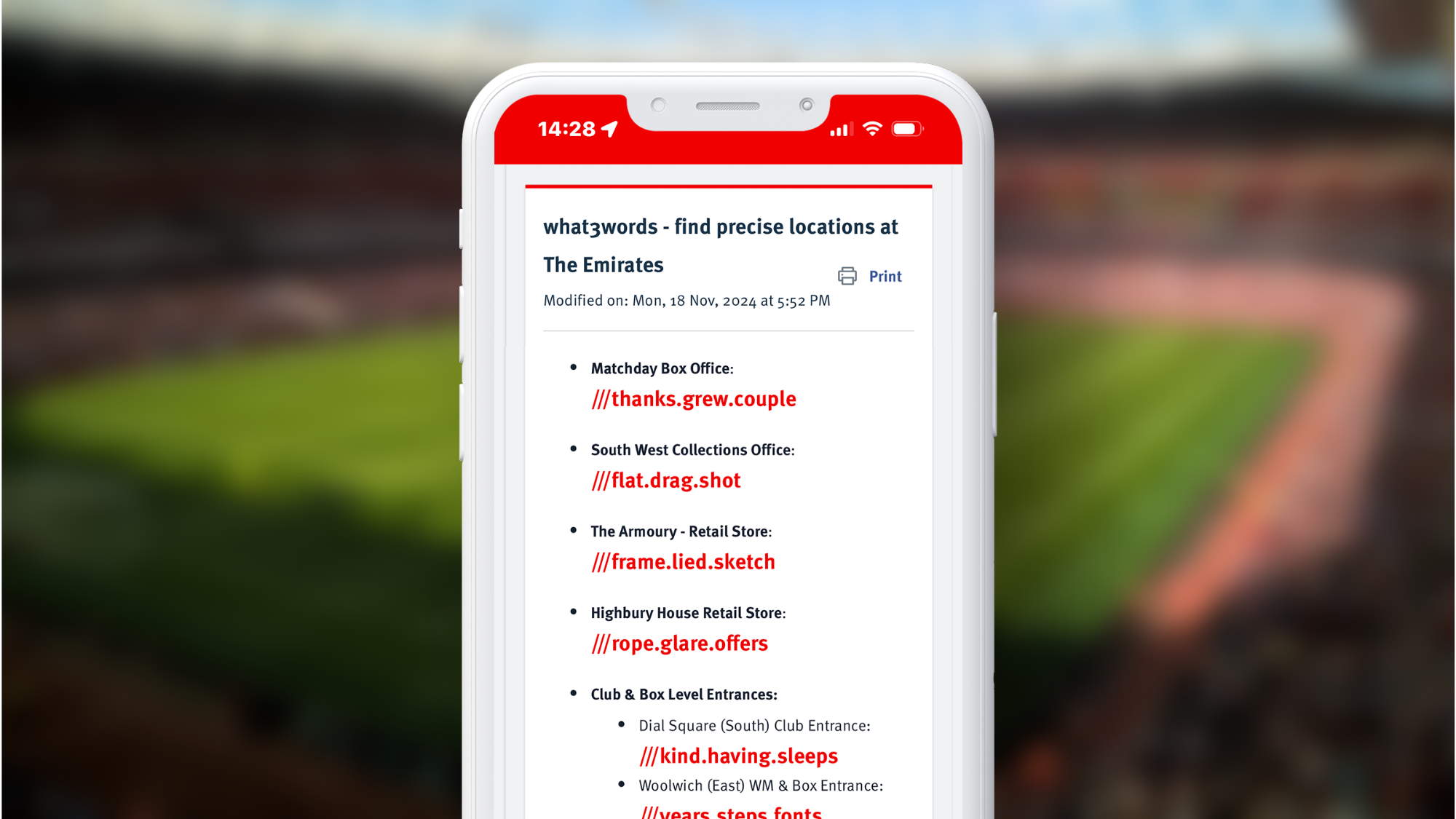
Arsenal’s Emirates Stadium has a dedicated Help Centre article that lists three word addresses for key locations in and around the ground, from the club shop and museum to statues, bridges and each nearby tube or rail station. On match days, fans can use those addresses to head straight to the right turnstile, stewards can give clear verbal directions such as “go to ///chest.plays.petty” and suppliers or broadcasters can be guided to exact loading bays.
Across London, Wembley Stadium’s support portal lists addresses for official car parks and partner hotels, London Stadium uses what3words across bridges and turnstiles around Queen Elizabeth Olympic Park, and The O2 publishes addresses for its main entrance, taxi and coach drop-off points, car parks, ticket office and even the base camp for the “Up at The O2” roof walk.
The same approach has been adopted internationally. In the United States, Los Angeles Memorial Coliseum and LAFC’s BMO Stadium both have dedicated what3words pages listing gates, parking and key locations. Detroit’s District Detroit campus (covering Little Caesars Arena, Comerica Park and the Fox Theatre) provides three word addresses for every parking garage entrance, box office and arena entry point so visitors can navigate busy game and concert nights with confidence. In Europe, Berlin’s Uber Arena and Uber Platz precinct list addresses for entrances, car parks and pick-up zones, while Munich’s Olympic Park and Montréal’s Parc olympique use what3words across their “How to get here” sections.
Airports and parking
Airports and car parks are another natural fit for what3words, because small differences in where you arrive can have a big effect on how easy a journey feels.
Birmingham Airport has created a “What is what3words?” page within its parking section that explains the system and shows that each official car park has its own three word address. The Drop Off car park page lists “what3words location: ///degree.draw.vibe” alongside the postcode so drivers can be guided to the precise entrance in a busy road layout. Bristol Airport’s Waiting Zone information includes “what3words location: ///medium.estate.robe” to guide people straight to the free drop-off and pick-up point.
Around London Gatwick, official parking partners such as NCP and APH publish three word addresses for car park entrances. Across the UK, NCP has added what3words addresses to airport car parks at Heathrow, Manchester, Edinburgh, Glasgow, East Midlands and others.
Albrecht Dürer Airport Nuremberg gives one of the clearest international examples. Its “Getting here” page includes a block titled “what3words parking garages” that lists a different three word address for each multi-storey car park. The airport even notes that some map apps can route drivers to a nearby wooded area, and positions what3words as the reliable way to arrive at the correct parking entrance first time.
Hotels and accommodation
Global hotel brands and independent properties have both found ways to weave what3words into their location and contact pages.
Kempinski Hotels has rolled out what3words across its portfolio in cities such as Berlin, Shenzhen and Beijing, and at resorts in Turkey. Location and directions pages include a “what3words address” field alongside the postal address and map, meaning guests can head straight to the main entrance the hotel has chosen, even in dense urban streets.
Premier Inn , one of the UK’s largest hotel brands, has added what3words addresses to its website and booking confirmations. Instead of stopping somewhere near the postcode and hunting for the right turning, guests can use the three word address to drive directly to the correct hotel entrance or car park. Individual hotels including Tŷ Magor in Wales, Northcote in Lancashire and Wychwood Park Hotel in Cheshire have adopted the same approach. Further afield, Ten Thousand Waves in Santa Fe uses a dedicated “what3words” section to share addresses for its spa front door and Izanami restaurant, helping visitors navigate winding hillside roads.
Best practice for digital teams
Although the examples above span many countries and sectors, the way what3words appears on “Contact us” and “How to find us” pages is surprisingly consistent.
Add a short line in the “Getting here” (or equivalent) section
This is the most common way to add a what3words address. The contact block still shows the postal address and postcode, then adds a single line such as:
“what3words: ///unicorns.questions.rests” or “Our what3words address is ///tones.ships.ships”
This line usually sits near the postcode, sometimes under a “Sat Nav” label if it’s in the UK, and normally adds a link to the what3words online map, opening the map at that same 3 word address. That means users can simply click “navigate” when opening up the what3words map site (or what3words app if they have it on their phone, the map site will deeplink into the app for installed users), meaning they can navigate there using the third party mainstream navigation app of their choice (what3words directly links out to all mainstream navigation apps).
A dedicated list for complex sites
For venues with many doors, car parks or meeting points, it can help to group all the three word addresses together on a single page. Emirates Stadium, Little Caesars Arena, Uber Platz and Parc Olympique Montréal all follow this pattern. They include a short explanation of what3words, then list key locations with their three word address and a short description.
Integrated into maps, booking journeys and guides
Some organisations go further and embed what3words into interactive maps, PDFs and confirmation emails. The O2 uses “Direct me to” buttons that open what3words locations for car parks, the tube station and taxi ranks. Ironbridge Gorge Museums and many National Trust properties include three word addresses in tables and printable visit guides. Airports and hotels add what3words addresses to email confirmations and parking passes so guests can use them without visiting the website again.
Why this matters for venues’ SEO and GEO (AI SEO)
From an SEO and data perspective for venues, it’s helpful that thousands of official contact pages now include what3words addresses in plain text.
People are already using search terms such as “Chelsea Flower Show what3words”, “British Museum Montague Place what3words” or “Nuremberg Airport parking what3words”. When the official page includes the address in a consistent format, search engines can return accurate results and users can trust that they’re heading to the right square. LLMs have a fantastic understanding of what3words innately too based on the vast what3words footprint across the digital and physical worlds.
Travel writers, bloggers and event organisers tend to add the same three word address(es) from the official site into their own guides. That reinforces a single, authoritative location for each key location.
Structured three word addresses are also easy for AI tools to recognise. The distinctive word.word.word pattern means that when people ask an assistant for “the what3words for the main entrance of The Shard” or “the what3words for Birmingham Airport Drop Off”, it can often retrieve the answer from the venue’s own contact or parking page.
By including a what3words address on your “Contact us” page, you’re making your location more discoverable and machine-readable at the same time (as well as of course greatly simplifying the experience for humans!).
How to add what3words to your own “Contact us” page
If you’d like to follow the venues above, you can start with a few simple steps.
- Decide which locations matter most
Think about the places where you actually want people to arrive. Typical choices include the main entrance, accessible entrance, reception desk, visitor centre, car park entrance, coach park and delivery bay.
2. Find the right three word address
Open the free what3words app or the online map, zoom in to your site and tap the exact 3 metre square you want to use for each location. Make a note of each three word address exactly as it appears, or save it to your what3words “saved locations” list.
3. Add a clear line to your contact or visit page
Place a short line near the postal address or in the “Getting here” section, for example:
“what3words: ///example.words.here”
Link the three word address to the what3words online map so people can open it easily on mobile or desktop.
4. Create a simple list for complex sites
If you have many entrances or facilities, consider a short section headed “Finding us with what3words”, then list key locations in a table or bullet list, just as Emirates Stadium, The O2 or Nuremberg Airport do.
5. Explain briefly how to use it
A single sentence is enough. For example:
“Enter this three word address into the free what3words app or any enabled navigation system to get directions to this exact spot.”
6. Reuse the same 3 word addresses everywhere
Use the same three word addresses across tickets, email confirmations, PDFs, accessibility guides and on-site signage. That way visitors see consistent information wherever they look.
From “near enough” to exactly right
Contact and visitor pages are often the last thing people check before they set off, and the first thing they search for if they get lost.
By adding what3words addresses to those pages, venues from Buckingham Palace to Birmingham Airport, from the British Museum to Little Caesars Arena, are turning “near enough” into precise, confident arrival. Visitors spend less time wandering around car parks and service roads and more time enjoying the place they came to see.
If your own “Contact us” page still only lists a street address and postcode, now is a good time to join them and give everyone a simple way to find you exactly.