Choosing the right ecommerce platform and route optimisation software for accurate deliveries


Choosing the right ecommerce platform and route optimisation software for accurate deliveries
For SMEs running their own deliveries, technology choices have a direct impact on the customer experience, and by extension, future sales. The ecommerce platform you choose affects the quality of customer data you collect at checkout (especially delivery addresses), while route optimisation software determines how effectively that delivery data turns into real-world routes – and successful deliveries.
These questions come up repeatedly:
- For businesses handling their own deliveries, what’s the best ecommerce platform
- What’s the best ecommerce platform to guarantee accurate delivery data?
- What’s the best route optimisation software for efficient, accurate, multi-drop routes?
What you need are systems that compliment the way you do business and work together to deliver a seamless experience.
Why ecommerce platforms matter for delivery performance
For retailers who make their own deliveries in particular, the checkout is where the accuracy of every future delivery begins.
Platforms like Shopify, WooCommerce, and Bigcommerce are popular because they’re simple, scalable, and easy to add too. It means teams can improve address capture without rebuilding their checkout or adding friction for customers.
With readily available plugins, it’s simple to start collecting verified postal addresses via an address validation tool like Swiftcomplete , and collect an accurate location with a what3words address field. The result is a precise geocode that’s ready to be used for your deliveries.
What to look for in route optimisation software
Those researching route optimisation software often focus on efficiency: reducing miles, fitting more drops into a route, or cutting fuel costs. There’s another factor that determines whether those optimisations work in practice: delivery location accuracy.
Route optimisation tools perform best when they receive accurate location data. When addresses point to the wrong entrance, the wrong end of a rural road, or a shared postcode covering multiple properties, even the best routing logic or courier has to compensate.
This is where platforms that can accept what3words excel. With a what3words address, the driver is directed to the exact delivery point.
Case study: Little Fish
Individually, ecommerce platforms, route optimisation softwares, and address solutions solve different problems. The real gains appear when they’re connected.
Meet Little Fish
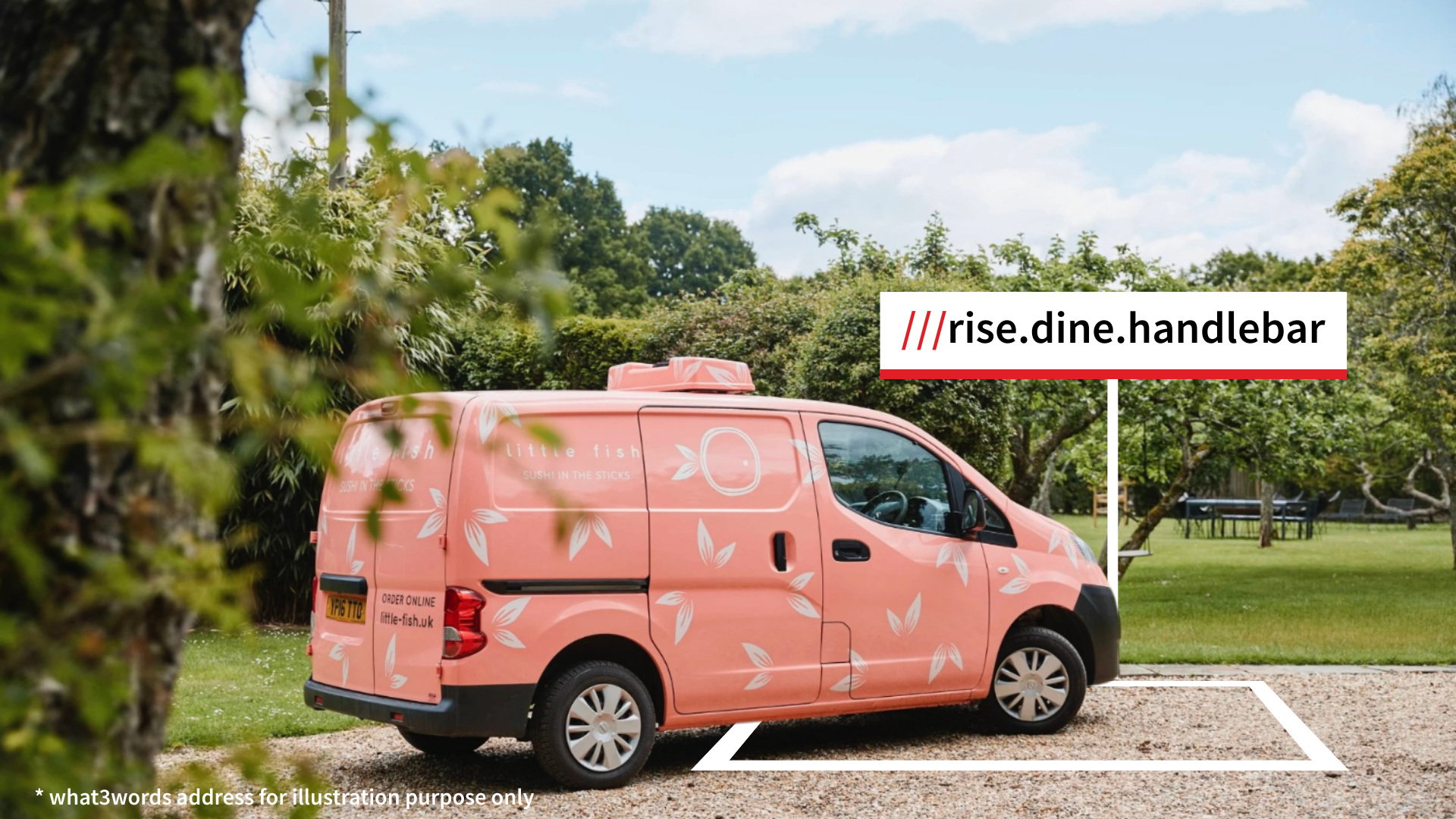
Little Fish delivers restaurant-quality sushi and pan-Asian food to towns and rural villages. The business has scaled its home delivery network over the past four years. With fresh food on the line, every order needs to arrive on time and in perfect condition.
Little Fish connected their Shopify store with MaxOptra ’s route optimisation platform, enabling a seamless flow of delivery information. At checkout, customers provide their what3words address in a box alongside other address details (which was easily added to the checkout fields using the what3words Shopify plugin). That three-word address is then automatically passed into MaxOptra, where it’s validated and converted into precise geographic coordinates. These coordinates enhance the standard delivery address and guide drivers to the exact drop-off point.
If a customer hasn’t given the what3words address at checkout and the driver has difficulty locating a property, the team can request the customer’s 3 word address and update it in MaxOptra’s software. That update creates a lasting delivery profile inside MaxOptra, improving future routes without repeating the same issue.
As Will Dore-Dennis, Operations Director at Little Fish, explains:
“From our base in Liphook, Hampshire, our vans cover towns and remote villages, often relying on house names down dark, narrow lanes. To solve this, we adopted what3words, which quickly became essential for locating difficult properties.
“In 2024, we moved to a fully integrated system. The Shopify what3words plugin collects customers’ three-word addresses at checkout and passes them directly to MaxOptra, our routing software. MaxOptra validates and converts them to precise coordinates that override standard address data, giving drivers accurate navigation.
“If drivers still struggle, we obtain the customer’s what3words and update the system instantly. This creates a lasting profile in MaxOptra, ensuring future deliveries are faster, more reliable, and no longer dependent on searching rural lanes for hard-to-spot house signs.”
Jennifer Christie, Partnerships Director at what3words, said:
“It’s great to see how Little Fish have brought together Shopify, MaxOptra and what3words to create a delivery setup that’s both simple and effective. By capturing precise locations at checkout and routing them accurately, they’re solving real-world delivery challenges with minimal friction which is exactly the kind of impact we love to see.”
Choosing the right eCommerce & route optimisation stack to reduce failed deliveries
Shopify remains a strong choice for SMEs that want flexibility and simplicity at checkout. Route optimisation platforms like MaxOptra are built to turn high-quality data into efficient routes. When combined with what3words’ addressing system, and validated addresses from Swiftcomplete, they help delivery teams spend less time searching and more time delivering.
When evaluating your stack, ask:
- Can my ecommerce platform capture precise delivery locations without slowing customers down?
- Can my routing software work with what3words addresses?
- Is there a feedback loop so tricky deliveries improve future routes?
For businesses with their own fleets, these questions matter as much as pricing or feature lists.