The checkout fix for 2026 that helps retailers selling bulky goods for the garden


Learn how retailers selling garden goods can reduce failed large item deliveries by capturing accurate delivery location data at checkout.
Spring doesn’t just bring more outdoor orders for retailers selling garden goods. It also brings more deliveries where vague location data becomes expensive very quickly.
A standard address may be enough to route a parcel. It is often not enough to complete a bulky garden delivery smoothly.
That is the real issue for retailers shipping sheds, BBQs, outdoor furniture, gravel, raised beds, compost, manure, or garden games such as swings, slides, ping-pong tables, and trampolines. These orders are harder to place, harder to reattempt and less forgiving when the final drop point is unclear.
In other words, the address may be correct, but the delivery can still go wrong.
What makes bulky garden deliveries harder to complete?
The postcode gets the driver to the property. But it does not always show the right entrance, access road, gate, courtyard, garage access or handover point. For smaller orders, that may be manageable. For bulky outdoor goods, it creates friction fast.
For larger orders, these typically require a two person delivery or pallet delivery. Pallet deliveries are typically delivered via 18-tonne vehicles equipped with a tail lift, making it even more critical that it’s delivered as close to the drop off point as possible. Otherwise it can be a timely and expensive mistake.
That friction shows up across the operation:
- more driver searching
- more customer calls
- more failed or delayed handovers
- more pressure on support teams
- more wasted time on high-cost deliveries
For retailers selling garden goods, this matters because spring brings more bulky orders. That means more deliveries where the final few metres matter.
Why is checkout the best place to reduce delivery ambiguity?
These delivery issues are often treated as a last-mile problem.
In reality, many of them begin earlier. The checkout confirms the order, but it does not always capture enough address information to help the delivery succeed.
That is where avoidable ambiguity creeps in.
A customer may know that delivery access is easier from the side road. They may know the front of the property is not the right place for a large delivery. They may know a new-build plot is hard to find using a standard address alone.
Customers can share their delivery address on checkout, but it’s not always easy for customers to share the precise delivery location.
If that precise address information is not captured at checkout, retailers usually try to recover it later through order notes, support queries or driver calls. That adds effort to a problem that could have been reduced before fulfilment even starts.
Why are large outdoor items less forgiving of vague address data?
This is what makes large garden orders worth thinking about separately.
A missed parcel is inconvenient. A missed bulky delivery is more operationally disruptive.
It can affect route efficiency, customer satisfaction and delivery cost in one go. That is why unclear location data matters more when the item is larger, heavier or harder to place safely.
Retailers do not need a longer checkout for the sake of it. They need checkout information that is actually useful.
What does better checkout address data look like for bulky garden goods?
For retailers selling garden goods, that usually means collecting more precise delivery information upfront.
This could include:
- accurate address autocomplete to ensure you’re collecting a valid address
- clearer delivery instruction prompts
- better guidance on access constraints
- a more precise way for customers to identify the intended delivery point
This is where Swiftcomplete and what3words can work well together.
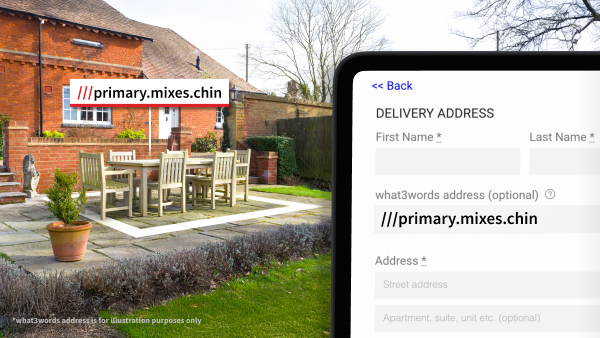
Swiftcomplete by what3words is an address lookup tool that allows customers to enter their address on checkout quickly and accurately via postcode, street address or what3words address for the ultimate precision.
what3words then adds an extra layer of precision by helping customers identify the exact delivery point for the order. Every 3 metre square has been given a unique combination of three random words: a what3words address. It’s the easiest way to communicate precise locations.
For a garden retailer, that combination can be especially useful on bulky deliveries. Swiftcomplete helps capture the address cleanly, while what3words helps capture where the item actually needs to go, whether that is a side gate, driveway entrance, or another practical handover point.
Why it’s worth using what3words if you’re selling garden goods
Spring garden orders increase the share of deliveries where ambiguity creates cost fast.
For high-value outdoor purchases, customers expect delivery to feel organised. If the order reaches the wrong place, arrives with confusion or needs multiple calls to complete, that shapes how they judge the retailer.
For retailers shipping bulky outdoor goods, checkout is a practical place to reduce delivery friction.
Swiftcomplete helps get the address in cleanly. what3words helps make the final delivery point clearer.
Capturing clearer location data upfront helps retailers, carriers and customers work from the same delivery point. And for large garden deliveries, that can be the difference between a straightforward handover and an avoidable operational problem.